
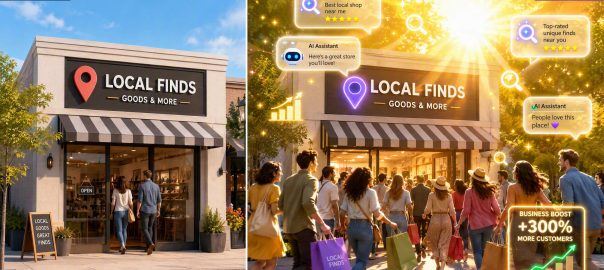
Google Maps or ChatGPT? With AI search visitors projected to overtake traditional search by 2028, your business could be invisible in one lane while thriving in the other. Which one are you missing?
Key Takeaways
- Small businesses get the strongest local visibility by blending AI SEO with traditional local SEO instead of picking just one approach.
- Traditional local SEO builds trust through Google Maps rankings, reviews, citations, and steady organic growth over three to six months.
- AI SEO speeds up keyword research, content updates, and competitor analysis, but it cannot replace backlinks or technical optimization on its own.
- Google AI Overviews are changing how often websites get clicked, even when they still show up in search results.
- Curious how a business actually earns a spot in an AI-generated answer? The factors behind AI Overview citations are covered further down.
Search has quietly split into two lanes, and small business owners are the ones stuck deciding which one to drive in. One lane is the familiar road of Google Maps pins, star ratings, and blue links. The other is newer: AI-generated answers from tools like ChatGPT, Google’s AI Overviews, and Gemini that hand shoppers a direct recommendation before they ever visit a website.
Why This Debate Matters Now
Local customers still search the old-fashioned way in massive numbers. Google alone processes more than 5 trillion searches per year, and a large share of those come from people looking for a nearby plumber, dentist, or coffee shop. That volume alone would be reason enough to keep traditional local SEO strong.
At the same time, a shift is underway that no small business can afford to ignore. Research from Semrush indicates AI search visitors may surpass traditional search visitors in 2028, particularly for digital marketing and SEO-related topics, meaning the businesses that show up in AI answers today are positioning themselves ahead of that curve. Be 1st Online has written about how local companies can start earning brand citations in ChatGPT and AI search, and that kind of visibility is quickly becoming its own competitive advantage rather than a nice extra. Businesses that treat this as an either-or choice risk missing customers on whichever side they neglect.
How Traditional Local SEO Works
Traditional local SEO is the slow-and-steady system that has powered small business visibility for years. It relies on manual keyword research, consistent content creation, backlink building, and a well-maintained Google Business Profile. Results take patience, usually showing stable movement over three to six months, but once a business earns its rankings, they tend to hold.
Google Maps Rankings and Reviews
Ranking well on Google Maps depends heavily on trust signals that build up over time. Recent, genuine reviews tell both Google and potential customers that a business is active and reliable, while consistent engagement with those reviews shows real ownership behind the storefront. A steady stream of positive feedback rarely happens overnight, which is exactly why this piece of local SEO rewards businesses willing to put in ongoing effort.
Citations, Website Optimization, and Backlinks
Local citations, meaning consistent mentions of a business name, address, and phone number across directories, help search engines confirm a business is legitimate and located where it claims to be. Pairing that with backlinks from relevant, reputable sites and a well-structured, fast-loading website rounds out the foundation. These elements work together:
- Local citations confirm business identity and location across the web
- Backlinks from relevant domains signal authority to search engines
- Website speed and structure affect both rankings and how long visitors stay
- Google Business Profile completeness ties everything back to local map results
None of these tasks happen instantly, but they create the kind of durable presence that keeps paying off long after the initial work is done.
How AI SEO Works
AI SEO flips the priority from patience to speed. Instead of grinding through keyword lists by hand, AI-powered tools scan large amounts of search data to spot patterns, identify what customers actually mean when they type a query, and surface content gaps competitors have missed. AI SEO speeds up execution rather than building authority on its own.
Winning “Near Me” and Conversational Searches
Conversational search behavior has changed what a “keyword” even looks like. One study found the average length of prompts where a brand appeared in ChatGPT, Google AI Mode, and AI Overviews was eight words, while other research shows AI Overviews appear most often for queries between six and ten words. That shift means small businesses need content that answers full questions, like “which bakery near me delivers custom cakes same day,” rather than just targeting short phrases like “bakery near me.”
Faster Keyword Research and Content Updates
AI tools can also analyze user behavior, search patterns, and competitor data to help small businesses create relevant content much faster than manual research alone allows. A task that once took a full afternoon, like identifying trending local search terms, can now happen in minutes. This speed advantage matters most when paired with a business that still commits to publishing and maintaining that content consistently, since AI research without follow-through produces nothing.
Why AI Overviews Change the Stakes
Google’s AI Overviews have introduced a wrinkle that traditional SEO metrics alone cannot capture. A business can rank well and still see fewer visitors clicking through, simply because the answer already appeared at the top of the page.
Impressions Up, Clicks Down: The Real Effect on Traffic
Studies show a notable reduction in organic click-through rate when AI Overviews are present, since users increasingly get their answer without needing to visit a website at all. Visibility and traffic have become two separate measures of success: a business can show up prominently in an AI Overview, earn brand recognition and trust, and still need other channels, like phone calls or direct visits, to convert that exposure into revenue.
The Factors Behind an AI Overview Citation
Getting cited inside an AI Overview is not random. Google tends to pull from businesses whose profiles are complete, whose reviews are recent, and whose structured data is clean and consistent across platforms. Third-party corroboration matters too, meaning other trustworthy sites mentioning the same business details reinforces that citation. On tools like ChatGPT, the stakes are even tighter, since these platforms often recommend only two or three businesses per query, leaving little room for a business with an incomplete or outdated online presence.
Blending Both Approaches for Growth
AI SEO and traditional local SEO work together rather than compete. Traditional SEO supplies the trust, authority, and stable rankings that take months to earn but rarely disappear overnight. AI SEO supplies the speed and research depth that let a business react to trends and conversational search behavior almost immediately. A business leaning on only one side leaves gaps the other side was built to fill.
What Each System Still Cannot Replace
AI tools speed up research and content drafting, but they cannot manufacture backlinks, build genuine local citations, or fix technical site issues without strategic human input. Traditional SEO practices move too slowly on their own to keep pace with fast-changing conversational search trends. A small business that pairs AI-assisted research with hands-on technical optimization and citation building tends to see faster visibility while keeping the long-term stability traditional methods provide.
Tracking Success Across Both Channels
Measuring performance now means watching two different scoreboards. Traditional metrics like organic traffic, keyword rankings, and click-through rate still matter and should stay part of any regular reporting routine. AI SEO calls for a separate set of measurements, including:
- AI mentions, tracking how often a brand appears in AI-generated responses
- AI citations, tracking how often a brand is named as a direct source
- Share of voice, comparing visibility against competitors inside AI tools
- Sentiment analysis, showing whether AI tools describe a brand positively
Watching both sets side by side gives a small business a much clearer picture of where its marketing dollars are actually working.
Combining Both Wins the Local Search Race
Local search has become a two-front effort, and neither front can be safely ignored. Traditional local SEO keeps a business grounded in the Google Maps results and trust signals that customers have relied on for years, while AI SEO opens the door to the fast-growing world of conversational and AI-generated answers. Small businesses that build both into their marketing strategy position themselves for visibility today and resilience as search continues to change.
For a practical next step, consider starting with local SEO strategies built for small businesses that combine steady foundational work with the speed AI tools now make possible.