
Waiting 47 hours to answer a lead could be costing you customers right now. See why some businesses respond in under 60 seconds – and whether that speed is even worth the price tag.
Key Takeaways
- Businesses that respond to leads within 5 minutes are roughly 100 times more likely to connect with them than those who wait 30 minutes, according to the MIT Lead Response Management Study as cited by Harvard Business Review, yet the average contact form response time is still 47 hours
- Live chat typically converts between 5-15% of visitors while contact forms average 2-5%, but live chat costs far more to staff properly
- AI chatbots can handle 70-80% of routine questions, though McKinsey’s 2025 customer experience research found that 62% of customers report frustration when chatbots handle complex issues, making a hybrid setup worth considering
- Matching the right lead capture tool to a business’s sales cycle and traffic volume can meaningfully lower customer acquisition costs over time
- Be 1st Online’s leads widget is built around the idea that fast responses and smart tool selection go hand in hand
The 47-Hour Response Gap Costing You Leads
Every local business owner has felt this sting: a promising customer fills out the contact form, and by the time someone gets around to replying, that customer has already booked with a competitor. This comes down to simple math. The MIT Lead Response Management Study, as cited by Harvard Business Review, points to a striking pattern: businesses that respond to leads within 5 minutes are roughly 100 times more likely to connect with them than those who wait 30 minutes. Yet the average form response time across industries sits at 47 hours.
That gap between what customers expect and what most websites deliver is quietly draining leads out of local businesses every single day. The problem is fixable rather than permanent. Choosing between lead forms, live chat, and newer AI-driven tools comes down to understanding what each option actually does well, and where it falls short. Be 1st Online works with local business owners on exactly this kind of decision, helping them figure out which lead capture approach fits their traffic, team size, and sales process.
This guide breaks down the real differences between forms and chat, what each one actually costs to run, and how a hybrid approach can capture more leads without draining a small team’s time or budget.
How Forms and Live Chat Actually Compare
Forms and live chat solve different problems rather than compete as versions of the same tool. The data on conversion, speed, and cost makes that clear.
Conversion Rates: 2-5% vs 5-15%
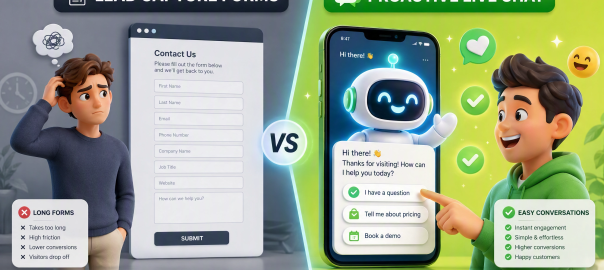
Contact forms typically convert between 2% and 5% of visitors into leads. Live chat performs noticeably better, usually landing in the 5% to 15% range. The reason comes down to friction: chat lets a visitor ask a quick question and get an answer without committing to filling out a multi-field form. A higher conversion rate does not automatically mean better leads, though. Forms require a bit more effort from the visitor, which tends to filter out casual browsers and attract people who are more serious about buying.
Response Times: 24-48 Hours vs 60 Seconds
This is where the two tools diverge most sharply. Contact forms average a 24-to-48-hour response window, and plenty of businesses take even longer once staff time and follow-up scheduling get factored in. Live chat, on the other hand, is expected to respond in under 60 seconds. Customers who open a chat window are not looking to wait; they want an answer right now, and if they do not get one quickly, they leave the page and often do not come back.
Monthly Costs: $100-500 vs $3,000-12,000
The cost gap between these two tools is significant, and it is one of the biggest reasons business owners hesitate before adding live chat. Running a contact form system, including basic software and the staff time to respond to leads, typically runs $100 to $500 a month. Staffing live chat properly during business hours, by contrast, is estimated at $3,000 to $12,000 a month once software, agent wages, training, and after-hours coverage are added up. That is a steep jump, and it explains why so many small businesses stick with forms even though chat converts better.
Why Cart and Form Abandonment Run High
Forms have a hidden problem that rarely gets discussed until it starts costing real money: people start filling them out and then quit halfway through. Baymard Institute’s 2026 research indicates cart abandonment runs high across industries, pointing to how many visitors drop off before completing an action.
The reasons behind this are fairly predictable once you look at them. Long forms with too many required fields scare people off. Confusing error messages make visitors give up rather than troubleshoot. Forms that are not optimized for phone screens create a clumsy typing experience that pushes mobile visitors away before they hit submit. None of these problems are unfixable, but they do require deliberate attention: shorter forms, smart field logic, and mobile-first design all help close that abandonment gap significantly.
The AI Chatbot Middle Ground
Between the low-cost, slow-response world of forms and the fast, expensive world of staffed live chat sits a growing option: AI chatbots. These tools promise round-the-clock availability without the payroll costs of a human team, and for a lot of routine questions, they genuinely deliver.
What Chatbots Handle Well
AI chatbots can answer 70-80% of routine questions accurately and operate 24/7, which makes them a strong fit for common, repeatable questions like store hours, pricing basics, appointment scheduling, or order status. For a local business fielding the same handful of questions over and over, a chatbot can quietly absorb that volume without anyone needing to be at a keyboard at 9 p.m. on a Tuesday.
Where Complex Issues Cause Frustration
The trouble starts when a conversation gets complicated. McKinsey’s 2025 customer experience research found that 62% of customers who interact with chatbots for complex issues report frustration. Nuanced questions, emotional situations, or anything requiring real judgment tend to expose the limits of even well-built AI. Handoffs to a human can also go badly if the customer has to repeat everything they already typed, which erases whatever goodwill the fast initial response created.
Matching the Tool to Your Business
The right choice depends heavily on what kind of business is asking the question.
B2B and Complex Sales Favor Forms
Businesses selling complex services, high-ticket B2B contracts, or anything requiring detailed documentation tend to do better with forms. Customers considering a big decision usually want time to think, and they are willing to type out their situation in detail if it means getting a thoughtful, well-matched response later. Forms also create a paper trail, which matters for industries where documentation is part of doing business responsibly.
E-commerce and SaaS Favor Live Chat
Online retailers and software companies tend to see the biggest lift from live chat, largely because their customers have quick, specific questions that block a purchase decision right in the moment: shipping timelines, product specs, or how a feature works. A shopper stuck at checkout with an unanswered question is a shopper who leaves. Immediate answers keep that transaction moving forward instead of abandoning it.
Professional Services Favor Video Chat
Local service providers, consultants, and similar businesses that sell trust as much as they sell a service often see the strongest results from video chat rather than plain text chat or forms. GreetNow’s own data indicates service businesses using video chat convert website visitors at 3 times the rate of form-only approaches. Being able to see and talk to a real person, even briefly, builds a level of confidence that text alone struggles to match, particularly for services where the buyer is trusting a stranger with something important.
Building a Hybrid Strategy That Works
The smartest approach for most local businesses involves designing a system where forms and chat each do the job they are best suited for, rather than picking one tool and abandoning the other.
A practical hybrid setup might look like this:
- Use a fast-loading chat widget on high-intent pages, like pricing or service pages, where visitors often have one quick question standing between them and a decision
- Keep a detailed contact form available for visitors who want to describe a complex need or are researching options before committing
- Add an AI chatbot layer to catch after-hours traffic and routine questions, with a clear path to a human for anything the bot cannot resolve
- Make sure one tool is clearly primary per page so visitors are not stuck choosing between two competing calls to action
This kind of layered setup lets a business capture the fast-moving, high-intent visitor through chat while still giving more cautious buyers the structured, no-pressure option of a form. Every visitor gets a path that matches how they prefer to communicate.
Choosing Wisely Cuts Acquisition Costs
The forms-versus-chat decision ultimately comes down to matching the tool to the business’s traffic, staff capacity, and sales cycle rather than chasing whichever option sounds more modern. A solo-run service business with modest traffic and complex jobs will likely do just fine with a well-designed form and fast follow-up habits. A higher-traffic e-commerce or SaaS site, on the other hand, stands to gain real revenue from live chat despite the higher staffing cost, simply because so many visitors are one quick answer away from buying.
Getting this choice right is fundamentally a matter of business impact. It directly affects how much a business spends to acquire each new customer, since slow response times and abandoned forms both translate into wasted marketing spend on leads that never convert. Testing a hybrid setup, tracking which pages perform better with chat versus forms, and adjusting based on real numbers tends to produce steadier results than committing fully to either extreme.
For local business owners ready to close their own response gap, checking out a leads widget built to combine fast response with smart lead capture is a reasonable next step toward lowering acquisition costs for good.