
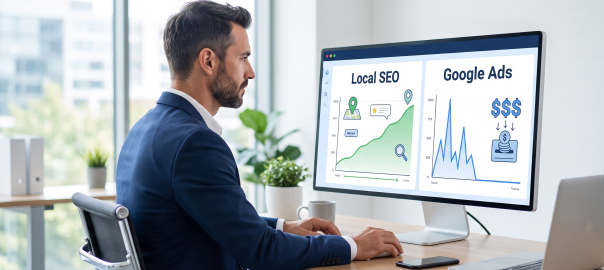
Most small businesses pour money into Google Ads every month, watching traffic vanish the moment they stop paying. But what if those same dollars could build something that keeps working long after the invoice is paid? The ROI difference might surprise you.
Key Takeaways
- Google Ads delivers fast visibility but charges for every click – and those costs keep rising.
- Local SEO takes longer to build but continues generating traffic long after the work is done, making it a true long-term asset.
- According to 2025 data, every dollar invested in SEO returned roughly $19.90 in value, compared to approximately $4.40 for paid ads.
- Research consistently shows that organic and Local Pack listings are perceived as more credible because they are earned, not bought, leading to a significantly higher click-through rate for organic results compared to paid ads.
- The smartest approach often isn’t choosing one over the other – keep reading to find out why both have a role to play.
For small business owners trying to grow online without burning through cash, few questions matter more than this one: where should the marketing budget actually go? Google Ads promises quick results. Local SEO promises lasting ones. Understanding how each model works – and what it really costs over time – makes the difference between a strategy that builds momentum and one that drains the bank.
Every Click Costs You – Until It Doesn’t
Every time someone clicks a Google Ad, money leaves the account. Stop paying, and the traffic stops too. For some businesses, that transaction is worth every cent. But for many small businesses operating on tight margins, the ongoing cost of buying every visitor adds up fast – and the moment the budget dries up, so does the visibility.
Local SEO works differently. It’s an investment in earned visibility – the kind that doesn’t disappear when a campaign is paused. Traffic generated through strong local rankings keeps coming in whether or not a dollar is being spent that week. That distinction is what separates a cost from an asset. Be 1st Online’s Be1st Multicast is built around exactly this principle – helping local businesses establish the kind of organic presence that works continuously in the background.
What Each Strategy Actually Does
Local SEO: Earned Visibility That Compounds
Local SEO is the process of making a business more visible in local search results – think Google Maps, the Local Pack (the map and three listings that appear at the top of local searches), and organic results for suburb or city-specific queries. Nearly 46% of all Google searches have local intent, with some recent data indicating this figure has climbed to 51% in 2026. Searches containing “near me” have increased by over 900% in the past two years alone.
A well-executed local SEO strategy typically includes optimising a Google Business Profile, building location-specific content, earning local citations, generating customer reviews, and improving overall website authority. These efforts compound over time – each improvement builds on the last, and rankings that are achieved tend to hold with regular maintenance. A case study from ITR Physical Therapy demonstrated just how significant this can be: a local SEO strategy resulted in a 412% increase in organic traffic and a 1,900% increase in monthly organic leads.
Google Ads: Instant Reach, Ongoing Cost
Google Ads operates on a pay-per-click (PPC) model. Businesses bid on specific keywords and pay each time someone clicks the ad. Campaigns can go live within hours and can be highly targeted by location, device, time of day, and demographics. For businesses that need leads immediately, the speed is hard to match.
The trade-off is straightforward: the traffic is rented, not owned. Once the budget stops, the visibility stops. There is no residual effect, no compounding benefit, and no digital asset left behind.
The Real Cost Comparison
What Small Businesses Pay for Google Ads
The numbers are sobering for many small business owners. Local businesses in America typically spend between $1,000 and $15,000 per month on Google Ads in 2026, with many small businesses falling in the $1,000-$5,000 per month range. Highly competitive sectors – legal services, for instance – can see CPCs ranging from $50 to over $200 per click.
The trend is also moving in the wrong direction for advertisers. In America, Google Ads click prices rose 31% between January and May 2026, and are up 21% year-on-year – while search demand on those same keywords fell by 23%. Businesses are paying more for the same or fewer potential customers.
Why Local SEO Costs Less Over Time
Local SEO does require an upfront investment – website optimisation, content creation, technical improvements, and profile management all take time and resources. But unlike Google Ads, those efforts don’t expire. Once rankings are established, the cost per visitor drops steadily. While specific cost-per-lead figures for local SEO vary, studies indicate that SEO generally offers a more cost-effective lead generation strategy over time compared to paid advertising. The average cost per lead for Google Ads can range from approximately $66.69 to $178, depending on the industry and campaign specifics. Over a 12-month period, well-executed SEO often delivers a significantly higher return on investment, with some studies suggesting it can deliver nearly five times better return on ad spend compared to paid advertising.
ROI: Where the Numbers Get Interesting
$19.90 vs $4.40 Per Dollar Invested
The return on investment gap between the two channels is striking. According to 2025 data, every dollar invested in SEO returned roughly $19.90 in value, compared to approximately $4.40 for paid ads. Local SEO generally delivers a significantly higher long-term ROI compared to PPC, capturing more calls, more foot traffic, and more sales – all without a cost attached to every single visit.
Why Most Users Skip the Ads Entirely
There’s a trust dynamic at play that many businesses underestimate. Research consistently shows that organic and Local Pack listings are perceived as more credible because they are earned, not bought, leading to a significantly higher click-through rate for organic results compared to paid ads. For local searches, organic and Local Pack results receive a significant portion of clicks – with 42% of clicks on a local search results page going to Local Pack listings alone. That preference for earned visibility fundamentally changes the return-on-investment maths for any business counting on paid clicks to convert.
Speed vs Sustainability: The Real Trade-Off
Google Ads wins on speed – full stop. A campaign can generate traffic within days. Local SEO typically takes four to six months for meaningful results to appear, with stronger outcomes building through months six to twelve and beyond. For a business that opened last week or is running a time-limited promotion, that timeline matters.
Speed comes at a price – literally. Every month the ads run, the meter is ticking. Local SEO’s slower start is offset by the fact that it keeps working without a recurring bill attached to each visitor. The difference is between renting and owning.
When Google Ads Still Makes Sense
Google Ads isn’t the wrong choice – it’s just the wrong only choice for most small businesses. There are clear scenarios where paid advertising earns its place:
- New businesses that need enquiries while their SEO foundation is being built
- Seasonal promotions or limited-time offers that need immediate visibility
- Highly competitive markets where organic rankings take longer to achieve
- Emergency service providers where customers need answers right now
- New product or service launches that require fast market testing
In these situations, Google Ads fills the gap. The key is treating it as a bridge, not a destination.
Use Both – But Know Why
Businesses that consistently outperform their competitors tend not to choose between Local SEO and Google Ads – they use both with a clear purpose for each. Google Ads handles immediate lead generation while Local SEO builds the long-term foundation. As organic rankings strengthen, dependence on paid advertising naturally reduces, freeing up budget to invest further in content, reputation, and authority.
Google Ads also produces real-time keyword data – insights into which search terms are actually driving conversions. That data feeds directly back into the SEO strategy, making both channels sharper over time. Used together, they cover different parts of the customer journey and create a more resilient marketing engine overall.
For Long-Term Value, Local SEO Wins on Every Metric That Matters
When the full picture is laid out – ROI, cost per lead, user trust, traffic sustainability, and compounding growth – Local SEO outperforms Google Ads on every metric relevant to long-term business health. That doesn’t make paid advertising irrelevant; it makes it a tactical tool rather than a strategy in itself.
For small businesses looking to build something that lasts, the question isn’t really Local SEO or Google Ads. Understanding which one builds equity – and making that the priority – is what separates businesses that grow from those that stall.
Be 1st Online helps small businesses build sustainable local visibility through smart, results-focused digital strategies – visit be1stonline.com to see how they can help your business grow online.